
Equipment guide / For parents
How to size kids’ golf clubs
and adjust their grip as they grow.
Start with their height. Check how the club feels. Know when a small grip adjustment helps, and when it’s time for the next size.
The quick answer
Choose junior golf clubs using your child’s current height and the maker’s fitting chart. If an otherwise suitable junior club is only a little long, a small grip-down adjustment may help. As the child grows, they can move their hands back toward the top of the grip. A club that is much too long, too heavy, or already too short needs a different fit, not a workaround.
1. Size kids’ golf clubs by height, not age alone.
A birthday is not a fitting measurement. Two eight-year-olds can be different heights, and a set marketed for an age range may not fit both of them. Start with a height measurement, then check the sizing chart for the exact brand and model you’re considering.
U.S. Kids Golf, for example, asks parents to measure the player in shoes and uses player-height ranges. That is its fitting system, not a universal chart for every junior brand. [1]
How to measure your child
- Follow the manufacturer’s instructions about shoes. For a shoes-on chart, use normal golf shoes or sneakers, not thick platform soles.
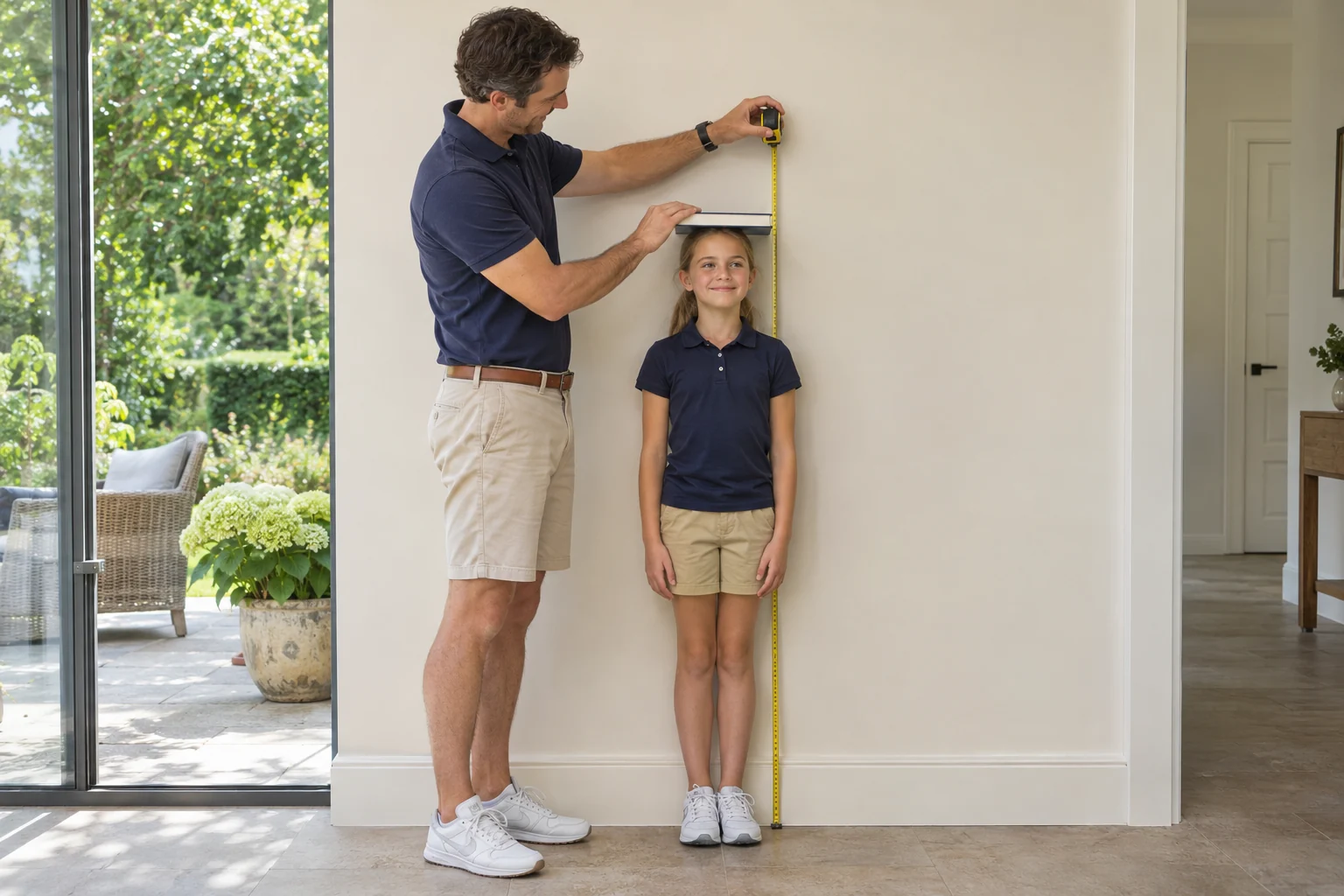
- Have your child stand upright on a level floor beside a wall, with feet flat, arms relaxed, and no hat.
- Place a flat book level on the crown of the head and mark its underside on the wall.
- Measure from the floor to the mark. Record the height, whether shoes were worn, and the date.
Example: a child who measures 51 inches is about 129.5 cm tall. Look for that player height on the maker’s chart. If the maker labels a size “51” by player height, that does not mean buying a 51-inch-long club. Each club in the set has its own length.
| Check | What it tells you |
|---|---|
| Current player height | The starting point on the manufacturer’s size chart. |
| That model’s height range | Whether this particular set is intended for a child of that height. |
| Comfortable setup and control | Whether the chart’s starting recommendation works in practice. |
| Weight, grip, and shaft | Whether the club is manageable, beyond its length. |
For a more detailed fit, a fitter may also use wrist-to-floor measurements and information about the player’s game. PING’s junior fitting approach includes those inputs. Height helps you start; it does not describe everything about a golfer. [4]
2. Check the club with the child, not just the chart.
Have an adult supervise in a clear practice area. Start without a ball and without swinging. Ask your child to take a relaxed setup with a junior iron: a small bend from the hips, softly flexed knees, and arms in a comfortable position.
- Look for a natural reach. Can they place the clubhead behind an imaginary ball without an exaggerated crouch, locked knees, or hands held awkwardly high?
- Check the handle. Can both hands fit comfortably on the rubber grip?
- Ask how it feels. Does it feel manageable, or does the child struggle to hold and control it?
These observations are reasons to investigate, not a diagnosis from one pose. A coach or fitter can help separate equipment issues from a beginner still learning to stand and swing.
Length is only part of the decision. PGA guidance also emphasizes suitable club weight, junior grip size, and shaft flex. Shortening the playing length with your hands does not make a heavy adult club into a lightweight junior club. [3]
3. Should kids hold the club higher or lower?
“Higher” means closer to the butt end of the grip, the capped end farthest from the clubhead. “Lower” means farther toward the clubhead. It does not mean lifting or lowering the arms to force the club to fit.
Gripping down, also called choking down, means moving both hands together a short distance down the rubber handle. It reduces the effective length of the club. Keep the hands together and securely on the rubber; do not slide the lower hand onto the bare shaft.
Near the top
For a club that fits comfortably at its normal playing length.
A little farther down
A small adjustment can help when an otherwise suitable junior club is slightly long.
How much grip-down is reasonable?
First Tee – Greater Seattle suggests only a modest amount of extra length, roughly half an inch to one inch, with the player gripping down to fit. Treat that as a small adjustment to check, not permission to buy several sizes ahead. [2]
PGA guidance warns against needing more than about 1½–2 inches of grip-down. That is a sign the club may be too long, not a goal to work toward. [3]
If the club already fits, use a comfortable normal position. If it is too short, moving farther down makes the effective length shorter still.
4. Let the grip change as the child grows, within limits.
Suppose an appropriate junior club fits today with a small amount of grip-down. Later, as your child grows, check their setup again. They may be able to move both hands a little closer to the butt end while keeping the same comfortable posture.
Do not move the hands higher just because another month has passed. Recheck the actual golfer. Once the hands are already near the end, leaving fingers hanging over the cap does not create a longer club.
| What you see | What to try next |
|---|---|
| Club fits with hands near the top | Keep a comfortable normal grip. There is no need to choke down just because the golfer is young. |
| Junior club is only slightly long | Check whether a small grip-down adjustment restores a natural setup and easy control. |
| Child has grown since gripping down | Recheck fit and gradually reduce that grip-down if it improves the setup. |
| Hands are near the top, but the child must crouch or reach | Check the next size with a fitter rather than gripping over the end. |
| Large grip-down is needed or the club feels heavy | Try a better-fitting junior club. Hand position cannot solve every mismatch. |
A simple family routine is to record height about every six months, as the U.S. Kids Golf parent booklet recommends, and check sooner after a noticeable growth spurt. Recheck when the child says the clubs feel awkward, too. [5]
5. Know when to change size instead of changing the swing.
Arrange a fit check if the child needs a large grip-down, cannot hold the handle comfortably, or repeatedly changes posture to reach the ball. Also check when clubs feel difficult to control despite a manageable length.
Look at the set, not one favorite club. An iron that seems comfortable does not prove that the driver or putter fits. There is no guaranteed “two-season” lifespan for every set: growth, the original fit, and the model all matter.
To keep costs sensible, compare suitable used junior clubs, local loan or rental options, and the actual replacement terms offered by a seller. Do not buy oversized equipment solely to postpone the next purchase, and do not assume a future trade-up program exists unless the seller has published its terms.
Before the next practice
- Record current height and check the right manufacturer’s chart.
- Confirm both hands stay comfortably on the rubber grip.
- Check for a relaxed setup and manageable club weight.
- Use a clear practice area with adult supervision.
- Ask a coach or fitter when the fit remains uncertain.
Common questions about kids’ golf club sizing
Should I size kids’ golf clubs by age or height?
Start with current height and the specific manufacturer’s chart. Age can help identify a junior range, but two children of the same age may need different lengths. Check comfort, club weight, grip size, and setup before deciding.
Can my child choke down on golf clubs that are a little long?
Sometimes. A small adjustment of roughly half an inch to one inch can be worth checking with an otherwise suitable junior club. Both hands stay together and fully on the rubber grip. If posture or control still looks awkward, get a fit check rather than moving farther down.
How far down is too far for a junior golfer?
PGA guidance flags gripping down more than about 1½–2 inches as a warning that the club is too long. That is a warning threshold, not a target. A child who needs a large adjustment should try a better-fitting club.
Should kids move their hands higher as they grow?
If they previously gripped down, they may gradually move both hands toward the butt end as their fit changes. All fingers must stay securely on the grip. If they are already near the end and must crouch or reach to address the ball, reassess the club size.
Does a 51-inch junior size mean the club is 51 inches long?
When a manufacturer labels a size by player height, 51 inches describes the golfer’s height, not the length of every club. Drivers, irons, wedges, and putters have different lengths. Always read that brand’s size definitions.
How often should I check my child’s golf club fit?
A useful routine is a height check about every six months and after a noticeable growth spurt. Check sooner if your child changes posture, struggles with control, or says the clubs feel awkward. There is no guaranteed number of seasons for one set.
Keep learning with TROSS
The fit is the starting point. Give them a next step.
Clubs that fit are one part of getting started. TROSS kits bring junior clubs together with a bag, a practice net, a mat, golf balls, soft practice balls, and an included period of app access, connecting the equipment decision with a way to practice and learn together.
The TROSS app is being built to help kids and parents learn golf technique, understand rules and etiquette, and put lessons into practice through games and challenges. Parents who are new to golf can learn alongside their child, whether they want to play themselves or feel more confident helping.
Club selections, practice gear, and app-access periods vary by kit. Choose a suitable, permitted space and follow the equipment instructions with adult supervision.
Explore the TROSS appWorking preview. Training content and features are still being developed for launch.
TROSS starts club recommendations with player height and reconfirms fit before fulfillment. This guide is general parent education; final product and fit specifications are confirmed before fulfillment.
Put the fit into practice.
- How to help your child start golf, even if you don’t play.
Help your child start golf with equipment, practice ideas, a flexible first-month plan, and the rules, technique, and family learning planned for the TROSS app.
- 7 golf games kids can play at home, one putt at a time.
Try seven simple putting games for kids at home using a junior putter, soft practice balls, and flat targets. Includes adaptable rules and printable activity cards.
- How to plan a home golf practice area for kids.
Plan a kids’ golf practice area around the actual activity, club clearance, ball choice, net instructions, and adult supervision. Includes a printable setup checklist.
Sources & editorial notes
Prepared by TROSS Golf from the fitting resources below. Sources consulted November 5, 2026. This is general parent education, not an individual club fitting. No PGA or LPGA review or endorsement is claimed.
- U.S. Kids Golf: Advanced Fitting Center
Measuring player height with shoes on and using a manufacturer’s height-based fitting system.
- First Tee – Greater Seattle: Equipment Buying Guide
A modest amount of extra club length, gripping down, and avoiding clubs that are too long or heavy.
- PGA of America: Finding Clubs that Fit Your Junior Golfer
Limits of gripping down, junior club weight, shaft flex, and grip size.
- PING: Prodi G junior clubs and WebFit Junior
Fitting can consider height, wrist-to-floor measurement, skill, and other player information.
- U.S. Kids Golf: Early Start parent booklet
Periodic height checks as children grow. The booklet recommends checking every six months.
The measurement image was generated with AI for illustration. It shows no real customer or verified fitting session. The grip diagram is a simplified position guide. Follow the written measurements and a fitter’s assessment rather than measuring proportions from either visual.
Back to parent guides