
Parent guide / Practice games
7 golf games kids can play at home, one putt at a time.
Try seven simple putting games for kids at home using a junior putter, soft practice balls, and flat targets. Includes adaptable rules and printable activity cards.
The quick answer
For a simple home session, choose one putting game, a properly fitting putter, soft practice balls, and a clear, level rolling lane. Use small putting strokes, keep other people outside the club’s reach and ball path, and collect balls only when the putter is down. These are putting activities, not indoor chipping or full-swing drills.
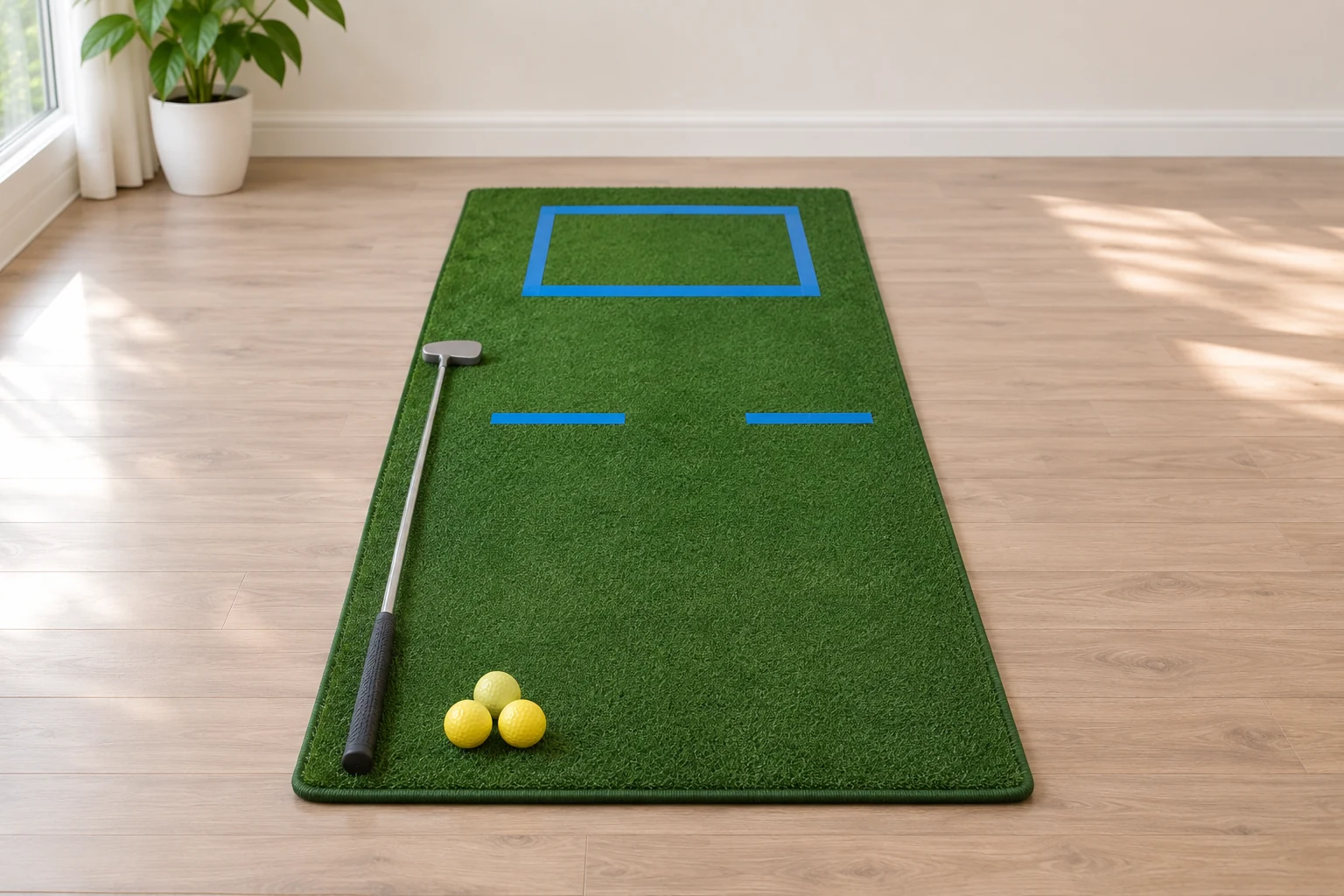
Before you play: set up for putting only.
These activities use a fitting junior putter, soft practice balls, a level rolling surface, and flat markers. No net or full-swing club is needed. Test tape on a suitable surface first and keep mat edges flat and secure.
Check the entire small putting-stroke area, not just the ball’s starting spot. Remove hard or fragile objects from the possible ball path. Keep siblings, pets, and waiting players outside the club’s reach and the rolling lane. Store balls and small markers away from younger children when finished.
Use a simple routine: one player, one ball in play, then club down before collecting. The PGA Jr. League safety guidance emphasizes looking before a swing and keeping others clear. Soft balls do not remove the need for supervision or prevent every injury or mark. [4]
Stop if the child begins making larger swings. Re-establish the putting activity or finish. These cards do not authorize chipping or full swings in the same room. For space planning, read how to plan a home practice area.
Seven printable putting activity cards
Choose one game to start. The names and play options below are TROSS family adaptations. PGA coaching resources also use putting games for indoor practice, but this collection is not a copied or endorsed PGA program. [1]
Practice idea / Start direction
1. Gate Roll
- Set up
- Place two short, flat tape strips across the same forward line, leaving a generous gap between their inner ends. The opening should be comfortably wider than the ball. Choose a nearby starting point.
- Play
- Roll one ball through the gap using a small putting stroke. Try a few turns, then swap players. Count successful rolls only if the child wants a score.
- Make it easier
- Widen the gap or move the start nearer.
- Try next
- Narrow the gap a little while keeping it achievable. Do not add a longer stroke just to make the task harder.
Practice idea / Distance control
2. Parking Lot
- Set up
- Make a large rectangular target zone with tape lying flat on the mat. Leave clear rolling space before and beyond it.
- Play
- Try to stop a soft ball inside the zone. A ball that passes through without stopping is a different result from one that stays parked. Let the child notice the difference.
- Make it easier
- Make the parking area larger and start closer.
- Try next
- Make the zone slightly shorter, or choose another starting point within the approved lane.
Practice idea / Choosing a suitable pace
3. Distance Ladder
- Set up
- Mark three broad, flat stopping zones at short, medium, and longer distances within the same clear lane. These are relative distances for your space, not prescribed yardages.
- Play
- Use one ball at a time. Try to stop near the first zone, then the second, then the third. Collect balls only after the putter is down and the adult says the lane is clear.
- Make it easier
- Use two zones and make them wide.
- Try next
- Let the child choose the order of the zones before starting.
Practice idea / Taking turns and cooperating
4. Three-Ball Team
- Set up
- Use one broad target zone and choose a starting point that both players can manage. Only the active player holds a club in the play area.
- Play
- Take three attempts as a team, one at a time. Decide on a small shared goal, such as getting one ball to stop in the zone. Celebrate working together, then choose whether to repeat.
- Make it easier
- Bring the start closer or remove scoring entirely.
- Try next
- Let each player choose a different permitted start, so the adult does not need the same advantage as the child.
Practice idea / Planning a putt
5. Choose Your Start
- Set up
- Mark two or three starting spots along one lane, all aimed at the same flat target. Use flat tape rather than raised objects.
- Play
- Before each attempt, the child chooses one start and says what they are trying to do. Use only one starting spot at a time; nobody stands at the other markers during play.
- Make it easier
- Offer two nearby starts with a wide target.
- Try next
- Ask the child to predict which start will need a gentler stroke, then test it. A prediction is not a test they have to pass.
Practice idea / Aiming at a selected target
6. Color Call
- Set up
- Place two broad, differently colored flat targets toward the far end of the same clear lane. Both must have clear space beyond them.
- Play
- Choose or call a color before the golfer takes their setup. Try to roll the ball toward that target. Never surprise the child with a new instruction during the stroke.
- Make it easier
- Use large target areas that are close together.
- Try next
- Let the child call a color for the adult, then take their own turn.
Practice idea / Creativity and ownership
7. Design a Hole
- Set up
- Let the child select one start and one flat target inside the already approved lane. The adult checks the layout before play. Keep ramps, furniture obstacles, glass cups, and raised barriers out of it.
- Play
- Give the hole a name and take turns. Decide whether the aim is to touch the target or stop inside it. The child can change one rule between rounds, with the adult checking that the new version still fits the space.
- Make it easier
- Choose a very close start and a broad finish.
- Try next
- Let the child explain the layout and rules to another family member before anyone picks up a club.
Make the game fit the child.
Adjust target size, the starting position, or the scoring rule. Change one thing at a time so the child can understand what changed. Keep every version within the same checked space and small putting-stroke limit.
- A simpler option: a nearby start, a broad target, and no score. Repeat a favorite game rather than insisting on all seven.
- A little more independence: let the child choose between two games and decide whether to keep a score.
- A child who wants a challenge: invite them to design a permitted layout or compare a personal result with their own last attempt.
These options can suit different ages and experience levels; they are not age-based performance standards. Avoid comparing siblings or making the activity a test of talent. PGA parent guidance supports simple instruction and encouragement focused on the process. [2]
If the putter looks difficult to control or the child must crouch or stretch awkwardly, check its fit before adding technical corrections. Use the junior club sizing guide or ask a coach.
Soft balls and different floor surfaces roll differently. Use these games for enjoyment, target awareness, and gentle pace exploration. Do not treat a score on this setup as a benchmark for course performance.
An optional short session
A TROSS kit pairs junior clubs and practice equipment with an included period of app access. The app is being built to help families connect technique and golf rules with games and challenges. Kids can try a skill while parents learn what it means, how the game works, and how to join in. These putting cards give you a simple activity to use now.
If your family wants a little structure, try this flexible example: a couple of minutes to check the area, a few minutes on one game, a second game if the child wants it, then club down, ball collection, and a quick conversation about a favorite moment.
It can fit into roughly 10–15 minutes, but that is a planning example, not a required amount of practice. Stop earlier when interest, attention, or control fades. The child does not have to finish a set number of attempts.
Before packing up, check the equipment and collect every ball. Manufacturer guidance also stresses keeping practice areas clear and inspecting equipment for wear. Use your own product’s care instructions rather than assuming a damaged mat or club is still suitable. [3]
Common questions
Can kids play these golf games indoors?
Only as putting activities in a checked area with soft practice balls, room for the entire small putter movement, and adult supervision. They are not indoor chipping or full-swing games. If the space cannot stay clear, choose another location.
Do I need a golf net for putting games?
No. These games use low, gentle rolls into flat target zones. A net is not a substitute for checking the putting area, and these activities do not establish that the space can support larger swings.
Should we use real golf balls in the house?
TROSS home-practice guidance calls for soft practice balls indoors. Clear people and breakables from the possible ball path anyway. Soft balls can still cause harm, and golf clubs themselves can injure someone.
Do we have to keep score?
No. A child can choose a target, take a turn, and enjoy the result without scoring. If scoring creates pressure, use a cooperative goal or remove it.
Keep learning with TROSS
Turn a favorite game into their next challenge.
Start with the putting games in this guide using a suitable junior putter and soft practice balls. TROSS kits bring those basics together with a bag, other junior clubs, a net, a mat, golf balls, and an included period of app access, so your family has equipment for more practice options as your child learns.
The TROSS app is being built to help kids and parents learn golf technique, understand rules and etiquette, and put lessons into practice through games and challenges. Parents who are new to golf can learn alongside their child, whether they want to play themselves or feel more confident helping.
Club selections, practice gear, and app-access periods vary by kit. Choose a suitable, permitted space and follow the equipment instructions with adult supervision.
Explore the TROSS appWorking preview. Training content and features are still being developed for launch.
Keep the next step simple.
- How to help your child start golf, even if you don’t play.
Help your child start golf with equipment, practice ideas, a flexible first-month plan, and the rules, technique, and family learning planned for the TROSS app.
- How to plan a home golf practice area for kids.
Plan a kids’ golf practice area around the actual activity, club clearance, ball choice, net instructions, and adult supervision. Includes a printable setup checklist.
- How to size kids’ golf clubs and adjust their grip as they grow.
Measure current height, check the fit, and learn when a small grip-down adjustment helps or a new size is needed.
Sources & editorial notes
Prepared by TROSS Golf. Sources consulted November 5, 2026.
The game names, layouts, scoring options, and session example are TROSS family activities built around ordinary putting-game concepts. They are not a PGA-approved program or a validated training prescription. Foam-ball speed does not reproduce the speed of a real putting green.
- PGA of America: 3 indoor golf games to improve putting
Putting games as an option for indoor practice; the seven family activities below are TROSS adaptations, not a reproduction of this article.
- PGA of America: 9 tips to help kids enjoy golf
Simple instruction, process-focused encouragement, and a positive family experience.
- The Net Return: Product usage guidelines
Checking balls and net wear, keeping the practice area clear, and following weather and care instructions for that manufacturer’s products.
- PGA Jr. League: Safety guidance in the 2020 Conditions of Play
The safety page emphasizes stopping to look before swinging, keeping others clear, and putting the club away while waiting. Referenced for these principles, not current competition rules.
For personal feedback on a persistent difficulty, a qualified junior coach can help. An app lesson cannot confirm an individual club fitting or approve a practice space. Manufacturer documents are referenced for their own equipment; they do not endorse TROSS or establish a fit for your home.
All parent guides